Claude only works when something wakes it up. Today you build the something.
You leave with: one thing that runs without you.
§01Where we are
EIGHT WEEKS IN.
Seven weeks of office hours, one progress check-in, a lot of building.
You started with prompts. Most of you now run skills and workflows every week.
19 Augustprogress check-in
What people showed.
Nine demos in an hour. All nine on real Oodle work.
WhoBuiltResultLevelNext
Adam GaventaFour linked skills: setup, plan, build, PR hand-offThree tickets run in parallel, three PRs4OperationalisingWire up the Jira hand-off
Richard HarrisAffordability notebook, plus a counterfactual web appThe same skill worked in another repo3SystematisingValidate it, package as a reusable skill
Michelle ClearySkills to recalc affordability for a new incomeA 15 minute task now takes about 23SystematisingTest with the team, then automate
Jack BroomeA Claude-maintained knowledge baseAlready saving real documentation time3SystematisingTrial GitHub as shared storage
Jennifer DavisMapped the commissions system through GitHubA developer signed off on it in a day2ApplyingGround it in runtime evidence
Adam ChappellA skill to run local integration testsWorks in the demo, not yet cross-repo3SystematisingValidate it, add to the skills repo
Vivek SharmaPulled audit evidence from several systemsTwo weeks of work, done in 2 to 3 hours2ApplyingDocument it, automate the repeatable steps
Poonam VyasInterview rubric plus a scoring prototypeTwo candidates trialled, useful feedback3SystematisingHR and legal review before rollout
Thomas HutchinsOne doc template across twenty servicesFirst docs produced, under review2ApplyingSort access, then a shared execution model
26 Augustthe follow-up check-in
Then five more.
A second session the next week. Different builds, same real work.
WhoBuiltResultLevelNext
David TomlinsonMailbox monitor: risk, capacity, fill date, drill-downBuilt on a train with patchy signal, still worked3SystematisingAuto-raise tickets, then remediation
Daniel HaylockMonthly finance pack rebuilt as a live artifactCFO comments on it, no manual pack next month4OperationalisingPair with an engineer on the architecture
Robert MackayComparing design docs against target stateDocs alone weren’t useful, still needs heavy review2ApplyingStop documenting, start building
Jamie MuirA Claude to-do list, critiqued and triaged dailyUsed every day, drives the weekly review3SystematisingAn agent that resolves to-dos on its own
Joshua RamsayA personal wiki Claude files and queriesAnswers “what did we agree with X” on demand3SystematisingA proactive weekly digest
Claude usage3 Aug – 1 Sep, governance review
The numbers agree.
89% of seats active this month. 25.6 billion tokens processed in 30 days.
Active57 of 64 seats, up from 72% to 89% across the monthMore than half the organisation opens Claude on a typical weekday.
Code92.6% of all tokens run through Claude Code, not chat23.7 billion of those tokens ran through Claude Code.
Habit30 to 40 people on a typical weekday, near zero at weekendsThe same 30 to 40 people show up each weekday.
Gap7 seats still idleA follow-up conversation, owned outside this session.
Skillsreach, chat + Claude Code · 3 Aug – 1 Sep
The on-ramp works.
51 people used at least one skill. The plainest tools reach furthest.
artifact-design23 users
docx18 users
pptx17 users
xlsx15 users
skill-creator12 users
artifact-diagramming11 users
One name, most of the volume41% of every skill invocation this month came from a single person.
Power usersClaude Code sessions · last 30 days
🎉Hugh Daman, most Claude Code sessions in the cohort
Nic Crane
413 sessions
2
Hugh Daman
1,441 sessions
1
Richard Harris
290 sessions
3
Hugh alone logged more Claude Code sessions than the next four people, combined.
Three of them
Two weeks became three hours.
An external audit. Evidence pulled from several systems, still checked by a person.
Vivekaudit evidence: two weeks of work, done in 2 to 3 hours
Michelleaffordability recalc: 10 to 15 minutes, down to about 2
Adam Gthree tickets in parallel, three pull requests
The tool beltwhat you already have
What’s in your hands already.
Skillsa markdown file that teaches Claude how you do a thing, onceOodle has a shared skills repo now. Eight people have committed to it.
MCPsa plug that gives Claude hands on a systemJira, Confluence, GitHub, Datadog. Read and write.
CLAUDE.mdthe rules of your project, read at the start of every sessionConventions, build commands, what never to touch.
Grillingmake it interview you before it builds anythingStill the highest-rated thing from July, and the cheapest.
MissingAll of it waits for you to type. Today, something else types.
The stackwhat sits on what
It stacks.
Autonomous agent systems
Agent to agent
Computer use
Cloud agents
Triggers routines · crons · events
Grill me
Review
Skills
MCPs
Instructions
The model
you have thistoday and after
What it’s for
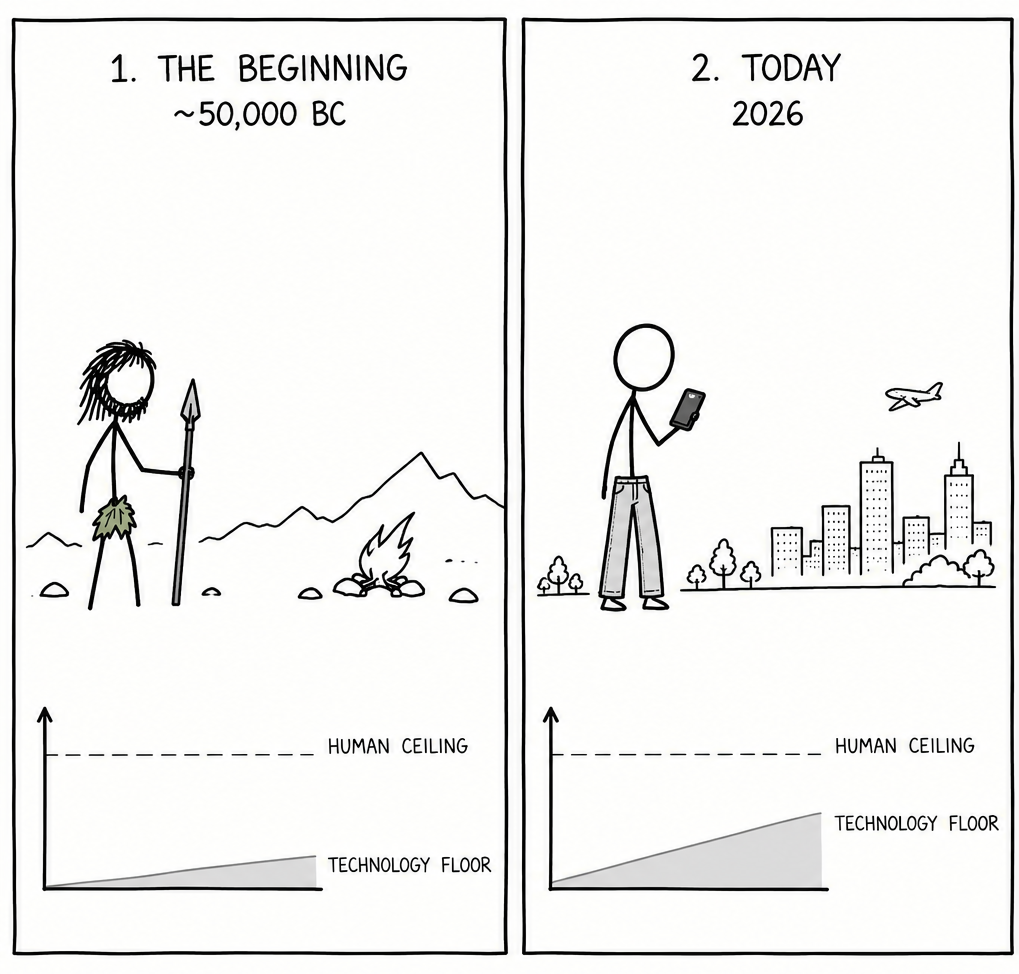
The floor rises.
01Blocksskills, MCPs, triggers
02Systemsblocks with clear steps
03Workdone while you are elsewhere
04Headspacefor the bigger things
Today
One new block.
Skills, MCPs and CLAUDE.md tell Claude what to do and what it can touch. None of them tell it when.
Haveskills, MCPs, project rules, grilling
Addingtriggers, and the check that makes them safe
Resultwork that happens while you are somewhere else
§02The building blocks
TRIGGERS.
The block that turns a tool into a process.
Everything you have built so far starts when you type. Something else can type.
The whole idea
There is no spontaneous thought.
Claude never wakes up on its own. Something has to poke it. Right now that something is you.
So faryou type, it answers, it goes quiet again
The movereplace “you type” with anything else
That’s itthe rest of today is what “anything else” can be
Two kindsthat’s all of them
Clocks and events.
01
A clock
Something happens because it is that time.
Every weekday at 08:00
Every hour
First Monday of the month
Claude calls this a routine. A server calls it a cron job. Same block.
02
An event
Something happens because something else happened.
A pull request is opened
A Jira ticket moves to Ready for refinement
A Confluence page is created
Datadog logs an error
Every trigger on this list was asked for in this room.
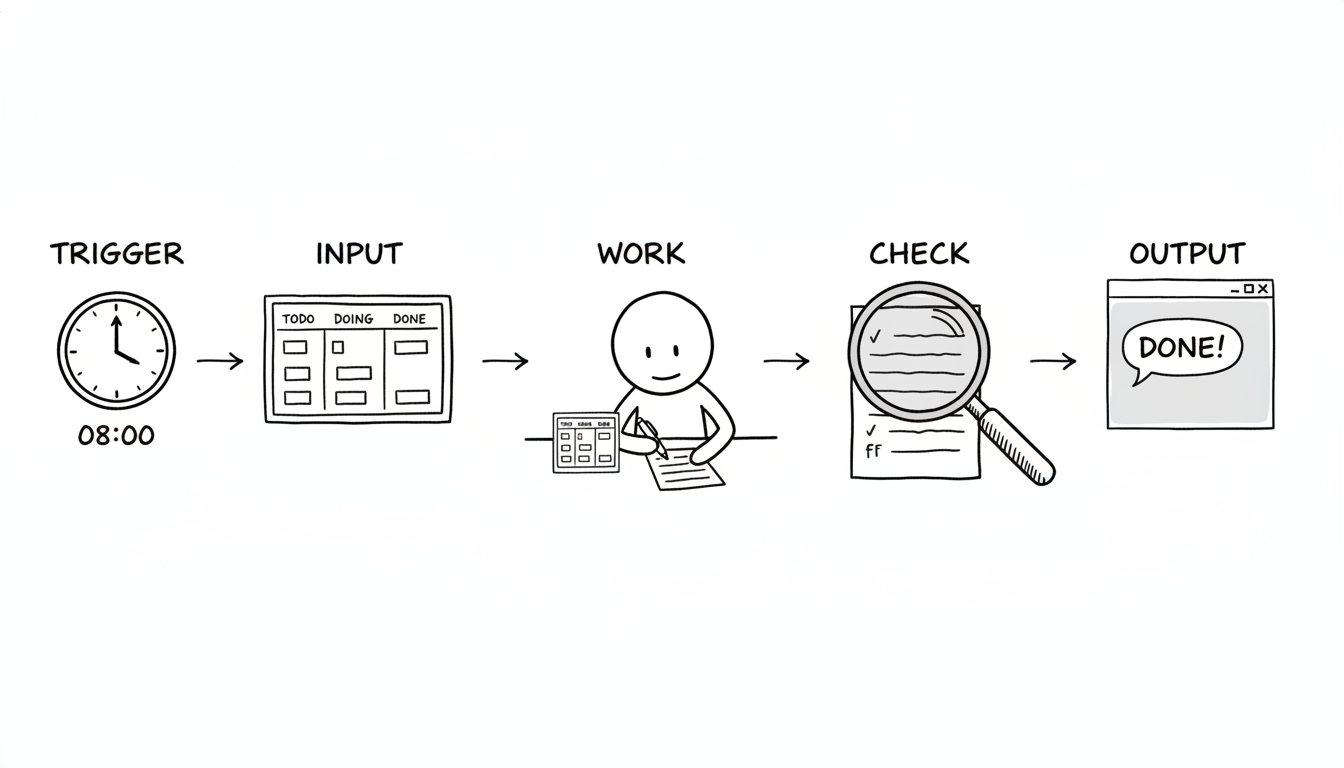
A systemhas steps
Five steps.
the idea
01Trigger
02Input
03Work
04Check
05Output
in practice
a routine a cron a PR opened
a message a Jira ticket a folder
a skill a prompt an MCP call
a test a second pass a source cited
a Teams message a PR comment a document
Same blocksdifferent builds
The blocks don’t change.
A daily brief and a fleet reviewing every PR are the same five blocks. One is bigger.
One
08:00, read yesterday’s tickets, write me a summary, check the numbers add up, drop it in Teams.
A few
Every PR, review it against our conventions, run the tests, comment if something is off.
Many
A queue of work, agents that claim it, agents that check it, a human who reads the summary.
Start smallEveryone starts at the first one. It is already useful.
A worked exampleone agent
This is what one looks like.
That’s itOne trigger, one input, one skill, one check, one place it lands. You could build this before lunch.
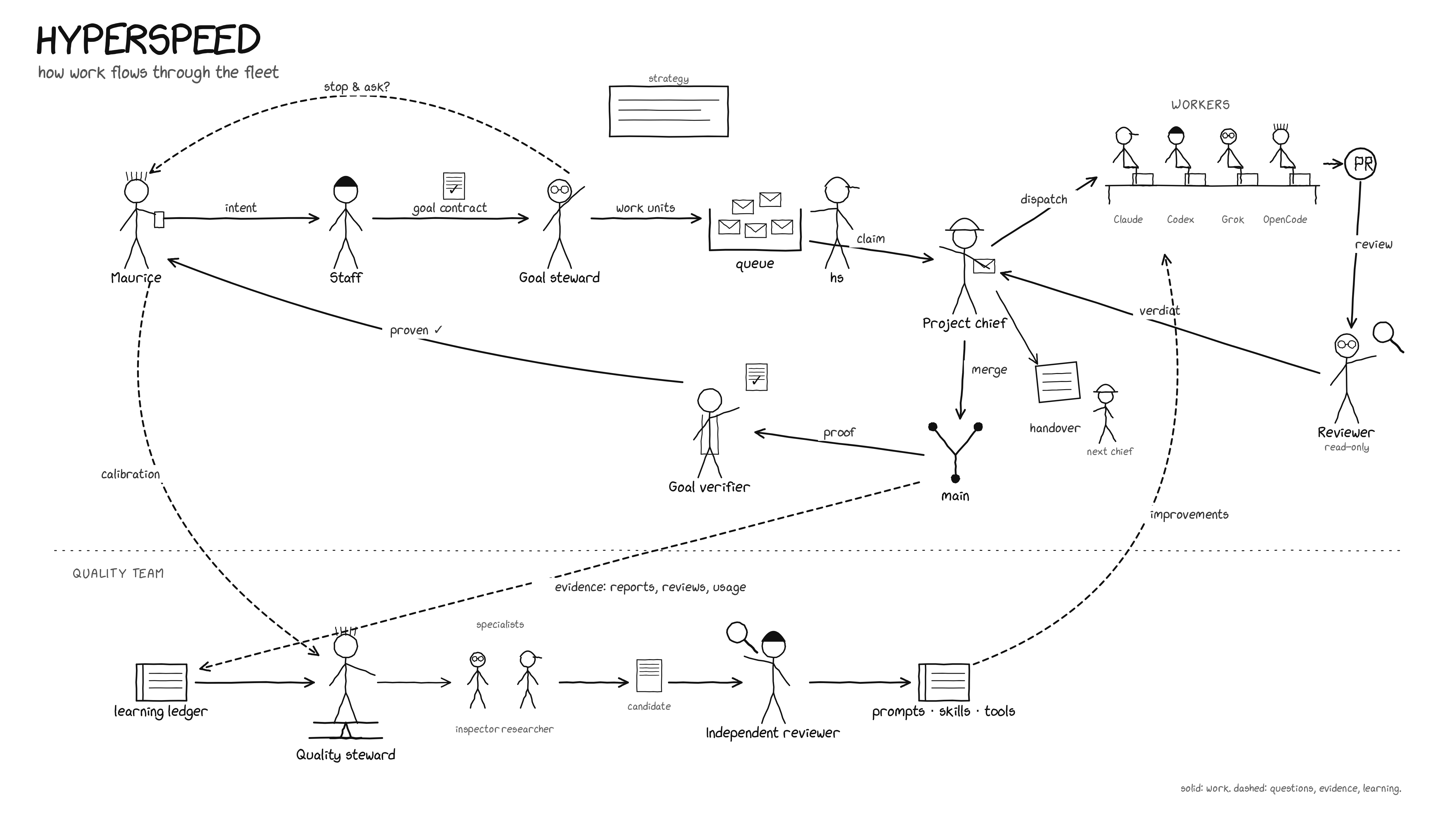
Same picturemore of them
And this is a lot of them.
The pointSame five steps, more of them. This is Maurice’s setup. It started as one routine.
Block 04the one people skip
A thing that runs alone needs a check.
While you’re in the loop, you are the check. Step out and there isn’t one. You have automated being wrong, faster.
Deterministica script, a test, a schema, a count that has to matchCheapest and most reliable. Use it wherever the answer is knowable.
Sourcedevery claim points at where it came fromJennifer hit this: Claude described dormant code as live. A source would have caught it.
Second passa fresh agent reviews the first one’s workFresh context, maybe a different model. Catches a lot.
Humanthe decisions that stay yoursAnything that touches a customer, a regulator, or production.
Rule for todayNothing this afternoon is done without one of these four.
Block 04, continuedwhat changes on a schedule
You won’t be reading every run.
You read the first run. Maybe the first ten. Then it becomes furniture and nobody looks. That is when a quiet wrong answer costs something.
Make it fail loudlyno output is better than a confident wrong oneIf the source is missing, say so and stop. Do not fill the gap.
Make it show its workingevery claim carries the ticket, page or line it came fromCheap, and it lets someone who wasn’t there review it.
Check on a schedule toospot-check the run once a week, on purposePut it in your calendar. Otherwise nobody looks again.
Keep the last oneso you can see when the output changed shapeA drifting answer is easier to catch against yesterday’s than against nothing.
In this roomClaude described dormant code as live, and switched off a test suite and reported it passing. Both were caught by a person. On a schedule, there is no person.
§03Two ways
PICK A SURFACE.
Terminal on the left, desktop app on the right, all the way through.
Every slide shows both. Work in your column, look across when you’re curious.
Two wayssame blocks, two surfaces
Same thing, two surfaces.
Terminal
You already live in a shell. Keep going.
claude -p
A cron entry, or a GitHub Action
Permissions pinned in the repo
Runs wherever you put it
Desktop app
No shell, no git. Same five blocks.
A routine
A schedule you pick from a menu
Connectors you switch on
Runs on Anthropic’s side
Read acrossSame idea, two places. Pick a column.
Anatomywhat you actually fill in
Five rows to fill in.
When0 8 * * 1-5Every weekday, 08:00
Whatclaude -p "…"The prompt it wakes up with
With.mcp.json · CLAUDE.md · skillsConnectors and skills you tick on
Then> out.md · gh pr commentBack to you, or into a doc
Checktests · a second passSources cited, or numbers that match
The fifth rowFour are easy. Check decides whether it can run while you sleep.
Mission · first trigger30 min
Make one thing fire on its own.
Something small and boring you do every week. Small and boring is the point.
01
Write the five blocks down firsttrigger, input, work, check, output. Two minutes, before you touch anything.
02
Build it in your columnterminal: get it working with -p, then schedule it. Desktop: create the routine and set the schedule.
03
Fire it by handdon’t wait for the clock. Make it run now and read what comes back.
04
Say what was wrong with itthere will be something. That something is your check.
30:00
T start / pause
You’re done when
It ran once without you typing the prompt, and you read the output.
Reachgive it something to look at
A trigger with no input just guesses.
Jiraacli / atlassian CLIAtlassian connector
GitHubghGitHub connector
DatadogpupDatadog connector
Your filesa folder in the repoA folder you point it at
Team habits.claude/skillsSkills you install once
Cheapest win in the roomPoint it at the shared Oodle skills. It then works the way your team works.
Mission · input and check30 min
Make it read something real, then prove it.
Same thing you just built. Now it reads your data and shows its working.
01
Connect one systemwhichever row from the last slide is closest to your work
02
Attach a skillone of yours, or one from the shared Oodle repo
03
Add the checkcite the ticket or page behind every claim, or count something you can verify by hand
04
Try to break itask about something that doesn’t exist. See whether it admits that or invents an answer.
30:00
T start / pause
You’re done when
It reads real data, and you have watched it either cite a source or admit it doesn’t know.
☕
Lunch.
45 minutes
Sit with someone from the other column. Ask what they built.
§04Build
ONE ROOM.
Both surfaces, mixed tables, your own work.
The rest of the day: build the thing you want, next to people you don’t usually sit with.
The brieffor the rest of the afternoon
One thing, running.
Build your own. Help the person next to you build theirs. If you both want the same thing, build it once and share it.
It fires on its owna clock or an event, not youIf you have to start it, it isn’t done.
It reads something realyour tickets, your docs, your logs, your filesSynthetic data is fine if the real thing is sensitive.
It has a checkone of the four from this morningThis is the one people will skip. Don’t.
Someone else could run itit isn’t glued to your laptop and your pathsWe come back to this at 15:15.
No idea? FineFour recipes on the hub. Take one, swap in your own systems, and it’s yours in ten minutes.
Mission · build90 min
Make it run without you.
We’re both walking the room. Grab us.
01
Write the five blocks down firsttrigger, input, work, check, output. Two minutes, before you touch anything.
02
Say it out loud to your tableif they can’t repeat it back, the brief is too vague for Claude too
03
Build the thinnest versionone input, one output. Add the rest after it works.
04
Attach the check, then let it fireand watch what it does
recipes and templatesmaterials link — TBC
90:00
T start / pause
You’re done when
It ran on its own trigger at least once, with a check attached, and you didn’t start it.
Next step upoff your laptop
Where does it actually live?
Right now it lives on your machine, with your paths and your credentials. Three moves get it somewhere else.
Put it in a boxa Dockerfile, so it carries its own dependenciesAsk Claude to write it. It stops depending on your laptop.
Push ita repo, so someone else can pull it and run itNic’s git guide covers this. You don’t need to learn git, you need to ask in the right folder.
Run it somewhere that stays onso it fires when your laptop is shutToday that is a routine, or your own machine. Oodle’s own answer is being built.
TodayGet to step two. A container and a repo is enough to hand over, and step three wants it anyway.
Over to Nic15 minutes
Where these will run at Oodle.
Nic’s slideNic Crane on the platform direction: a governed place for internal AI tools, what the container route looks like, ownership and decommissioning, and how other companies handle the same problem. Content from Nic.masterclass-deck/assets/nic-platform.png
§05Share it
HAND IT OVER.
A thing only you can run is a thing only you benefit from.
Eight people have committed to the shared skills repo. All eight are engineers. That is plumbing.
The gapworth naming plainly
Building isn’t the bottleneck.
Pricing, finance, analytics and data science have shipped some of the most useful things in this cohort. Almost none of it has reached anyone else.
What happened
The shared repo needs git. Git is an engineering tool. So the repo filled up with engineering skills.
What it looks like
From the outside it reads as though only engineers are doing the work. The repo counts commits, and most of this cohort has never made one.
What we’re doing
Two routes out. One needs no git at all. The other is git, with a guide.
Route oneno git, no terminal
Share it where you built it.
Publish the skillthe same skill, available to your team from ClaudeThey install it once. Your way becomes their way.
Hand over the routinethe prompt, the schedule and the connections as a description someone can recreateJamie already offered to export his to-do setup this way.
Share the output, not the machinea link that updates itselfDaniel’s finance pack. The CFO comments on it directly.
Still review itA skill is instructions your colleague’s agent will follow. Someone reads it first, like a pull request.
Route twogit, without the fear
Into the shared repo.
The Oodle skills repo is split by discipline, and each area reviews its own. Common is for anything that works everywhere.
Pick your areacommon, data, java, product, python, salesforce, sre, webFinance has its own space. Nobody has used it yet.
Let Claude do the git partthe repo’s CLAUDE.md explains its own conventionsYou don’t need to learn git. Ask in the right folder.
Someone in that area reviews ita small gate, so a broken skill doesn’t break everyoneNic’s team can approve anything if your area is quiet.
New todayNic wrote a beginner’s guide to git and GitHub for Oodle. Start there.
Mission · share20 min
Give it to one person.
Not the whole company. One named colleague, today.
01
Name themsomeone who does the same task you just automated
02
Strip the parts that are yoursyour file paths, your folder names, your credentials
03
Send it by whichever route fitspublished skill, shared repo, or a written handover
04
Watch them run itif they get stuck, fix the handover
20:00
T start / pause
You’re done when
Someone who is not you has run the thing you built, on their own machine.
§06Close
BY 15 OCTOBER.
Five weeks, then we all sit in a room again.
One sentence each. What is running by then, and who else is using it.
Round the roomone sentence each
What’s live by Demo Day?
Not a plan. The thing running on its own when we’re back on 15 October.
By 15 October,this runs on its own
It fires ona clock / an event
The check is
Also used by
We write these downWe bring the list to office hours, so nobody has to remember what they said in September.
Between now and then
What’s next.
Weeklyoffice hours carry on, same timeBring the thing that broke, not the thing that worked.
Nic and Davewhere these things run when they outgrow your laptopGoverned hosting, ownership, and who patches it. That work is live.
15 OctoberDemo Day and the last hackathonCost and running these at scale, plus what you shipped.